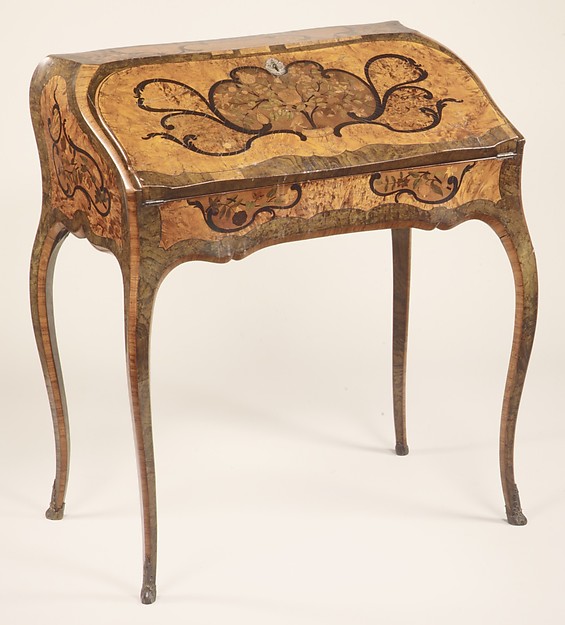
Slant-Front Desk
Attributed to Heinrich Ludwig Rohde (German, 1683–1755) or Ferdinand Plitzner (German, 1678–1724) · Germany · c. 1720
German cabinetmaker Heinrich Ludwig Rohde worked in Mainz, a prosperous university town on the Rhine River. As court cabinetmaker to Elector Lothar Franz Schönborn, Archbishop of Mainz and Prince of the Holy Roman Empire, Rohde was responsible for much of the decoration at the Schönborn's sumptuous palace at Pommersfelden, from the marquetry floors and mirrored cabinets to the porcelain-decorated rooms. The marquetry incorporates varieties of wood that would have been readily available in Germany, like maple, walnut, spruce, and oak, as well as costly imported materials like mahogany and amaranth. They are finely pieced together in geometric and naturalistic patterns; at the center of the fall front is a salamander, a creature able reputed by myth to be invulnerable to fire. An unusual motif, it probably held some kind of significance for the desk's original owner.