Armchair
Maker unknown · Philadelphia · ca. 1750
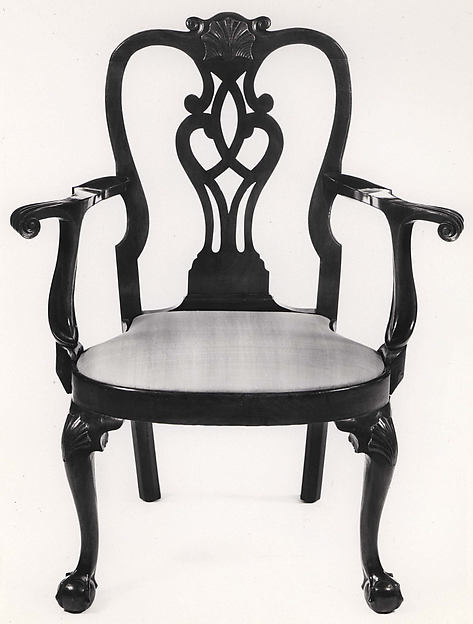
This armchair was made around 1750 in the wealthy colonial port city of Philadelphia. It is a superlative example of Baroque, or Queen Anne style, furniture made in the American colonies. A main characteristic of the Queen Anne style is the S-curve, which artist William Hogarth called "the line of beauty." Here, the serpentine S-curve becomes the chair's decoration. The back, seat, arms, and legs are all curves that intersect and echo each other and give the chair a sense of animation. The graceful design emphasizes the beauty of the wood, which is black walnut, an indigenous American hardwood. The curves are punctuated by areas of carving that include shells, scrolls, and ball-and-claw feet. This type of foot was employed by British furniture makers in the second quarter of the eighteenth century, but it fell out of fashion relatively quickly. It was widely used in the American colonies, where it was associated with the Rococo, or Chippendale, style. It is unusual to see a colonial chair of this early date with ball-and-claw feet. The hoop-shaped arms were also rarely used by American chairmakers, but they effectively echo the outline of the crest and splat. The ample proportions, graceful curves, and carved details give the armchair a feeling of restrained opulence. When it was made, it would have represented the height of sophistication.