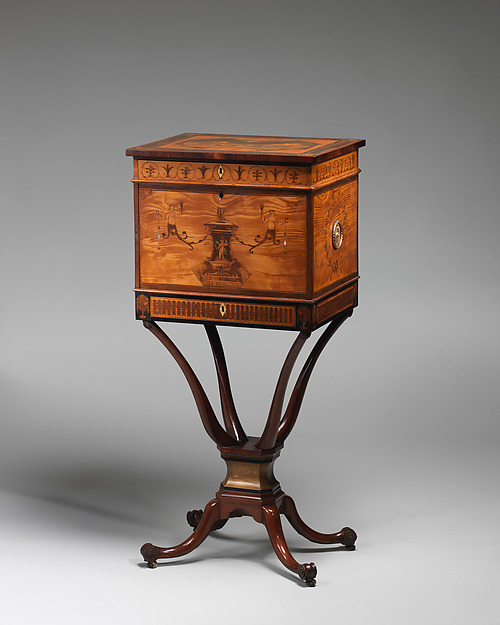
Cabinet on Stand
Attributed to William Vile (born England, about 1700–1767) · England · c. 1760
Both the manipulation of the veneers and the carving on this cabinet suggest an attribution to William Vile. Born in Somerset, England, in about 1700, Vile was working as a cabinetmaker in London by 1751, in partnership with the upholsterer John Cobb, and retired in 1764. Little of Vile's work is documented, apart from the pieces he made between 1761 and 1764 for his most important patrons, King George III and Queen Charlotte. While records survive describing many of the pieces made for the royal collection, it has not been possible to match this cabinet with any of those objects. Elongated cabriole legs of solid carved mahogany support the cabinet, which is veneered with quartered mahogany, framed by ebony moldings, and bordered by carved Rococo relief ornament. This relief work and the galleried superstructure are painted, probably to simulate ivory. The cabinet was most likely intended to hold coins or medals: coin trays are fitted into boxes that slide into the upper and lower interior compartments.