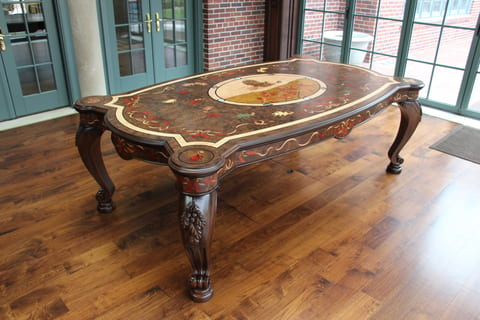
Center Table
England · England · c. 1755
Imagine how impressive this table would have looked when fully extended and set with silver at the center of a large hall glowing with candlelight. Made in England in the mid-18th century, it has a hinged top so that it could be placed against a wall when not in use. The table is made of mahogany, which was imported to England from Central America and the West Indies. The dense and fine-grained nature of the wood made it suitable for carving in relief, as can be seen in the virtuoso carving of the table's freize and legs. The legs have been shaped as rams' heads with scrolling horns in high relief and swags of vines suspended from their mouths. Like goats, rams were traditionally associated with Bacchus, the Roman god of wine, and thus revelry, indicating that the table was probably intended for a dining room or banquet room. 18th-century English furniture is rarely marked or labeled, even on pieces of the highest quality, like this one. Although the names of several cabinetmakers have been proposed, it remains difficult, if not impossible, to attribute the table to a particular designer or workshop.